Why Location Matters in Mini-Grid Development
Choosing the right location for a mini-grid involves far more than identifying communities without electricity. Drawing from a decade of experience in the DRE sector, this article explores why location matters in mini-grid development. Location isn't just about today—it's about building for sustainable impact tomorrow.
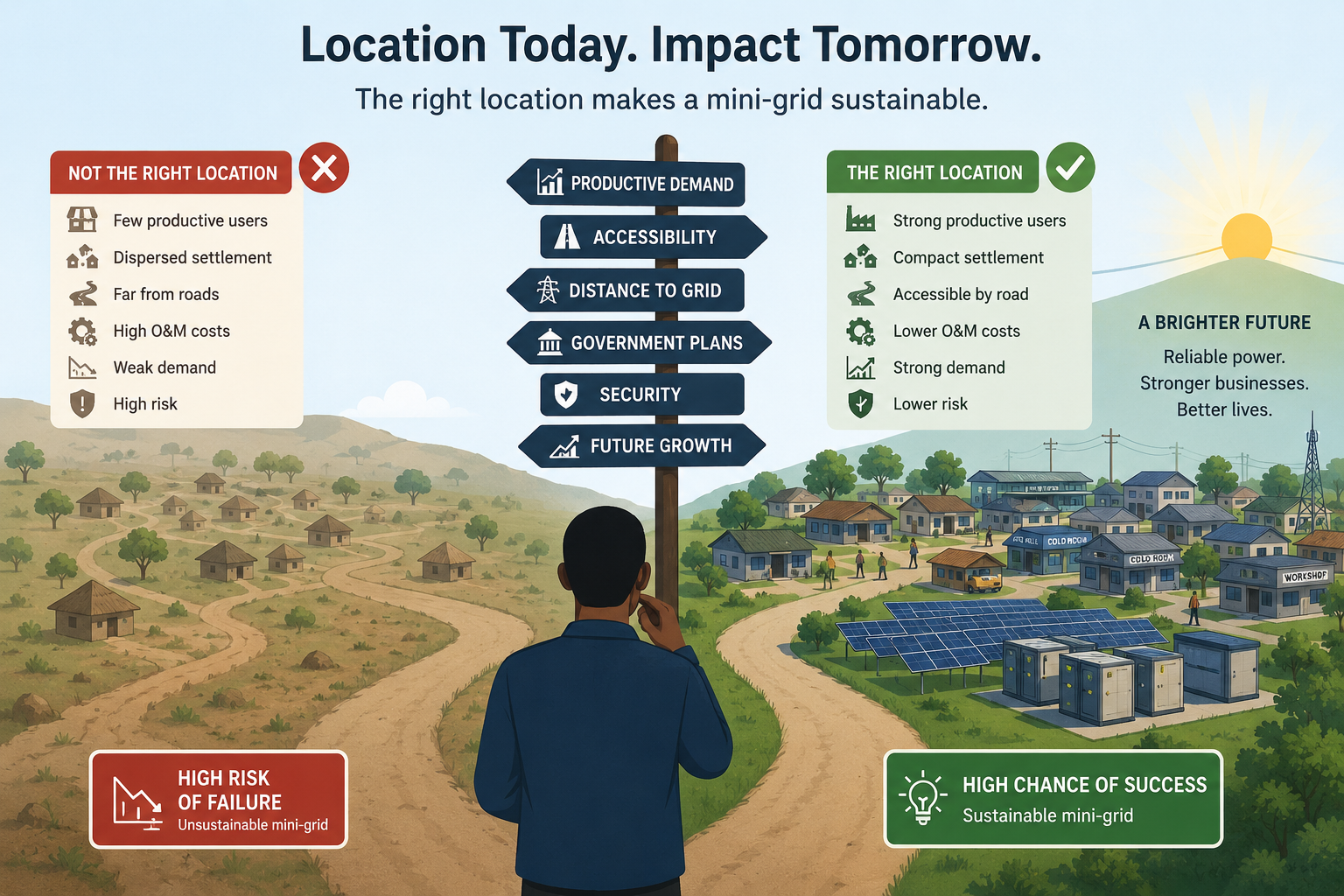
One of the biggest lessons I have learned after ten years in the distributed renewable energy (DRE) sector is this: not every unelectrified community should be the next mini-grid. That statement may sound surprising. To someone outside the energy sector, the solution often appears straightforward—find communities without electricity, build a mini-grid, and solve the problem. After all, electricity changes lives.
That was exactly how my own journey into energy access began. Years ago, I encountered a community that had lived without electricity since its inception. Compassion drove me to install a standalone solar system because the need was obvious. At that point, the absence of electricity alone seemed like sufficient justification. Ten years later, however, I have learned that compassion is an excellent reason to care, but it is not enough to determine where investment should go. Mini-grids are businesses before they are infrastructure projects, and businesses survive by making sound decisions. One of the most important of those decisions is where they are built.
One of the biggest misconceptions about mini-grid development is that every community without electricity automatically qualifies for a mini-grid. Unfortunately, it doesn't work that way. Even a large population is not enough. A community of 2,000 people may appear more attractive than one with only 800 people, but population alone tells us very little about whether a mini-grid can operate sustainably. Site selection is not simply about identifying communities that lack electricity; it is about identifying communities where electricity can be delivered sustainably while protecting the investment that makes that electricity possible.
Thousands of communities across Africa remain unelectrified, and many would benefit tremendously from reliable power. Yet only a fraction may be immediately suitable for mini-grid development because every site must be assessed against multiple technical, financial, regulatory, and operational criteria. This is why developers spend considerable time evaluating locations before construction ever begins.
This takes me back to the very first lesson in this series: a mini-grid is a business. Yes, it delivers social impact. Yes, it improves livelihoods. Yes, it transforms communities. But unless the project remains financially sustainable, none of those benefits will last. Developers invest millions of dollars into assets expected to operate for decades, while investors expect those assets to generate sufficient revenue to cover operations, maintenance, debt servicing, and future expansion. Choosing the wrong location threatens all of that, making site selection one of the most critical stages of mini-grid development.
The first question, therefore, is not "Who needs electricity?" but rather, "Which location presents the strongest business case?" Those are two very different questions. A community may desperately need electricity but still not be the highest priority for development today. Another community with similar needs may become the preferred choice because it offers stronger long-term viability. The goal is not simply to electrify communities; it is to electrify them in a way that allows projects to remain operational and financially sustainable for many years.
One of the first checks every responsible developer performs is understanding government electrification plans. In Nigeria, for example, developers must determine whether the local Distribution Company (DisCo) intends to extend the national grid into a proposed project area. Constructing a mini-grid in a community already scheduled for grid extension could expose both the developer and investors to significant financial risk. Nigeria's Mini-Grid Regulation provides a framework governing interactions between interconnected and isolated mini-grids, including what happens when the main grid eventually arrives. Understanding these regulations before selecting a site is therefore essential. Ignoring government planning is not simply poor planning—it can undermine an entire investment.
Fortunately, developers no longer rely solely on field visits. One of the most powerful tools available today is geospatial analysis. Satellite imagery, spatial datasets, and remote sensing technologies now allow developers to evaluate thousands of communities before ever setting foot on site. Depending on the available datasets, geospatial analysis can reveal information such as population estimates, settlement density, distance from existing electricity infrastructure, road accessibility, night-time light intensity, the presence of schools and healthcare facilities, commercial and productive activities, agricultural potential, community clustering, and terrain characteristics.
These datasets provide an early indication of whether a community deserves further investigation. They do not replace field surveys; instead, they ensure developers spend time evaluating the most promising locations first. The increasing use of geospatial planning in electrification has also been encouraged by organizations such as the World Bank, ESMAP, SEforALL, and the International Energy Agency, all of which recognize geospatial least-cost planning as a critical component of national electrification strategies.
Another lesson I have learned is that mini-grids are only one tool within a much larger electrification toolbox. Sometimes the best solution is grid extension. Sometimes it is a solar home system. In other situations, standalone systems provide the most economical option. The right technology depends entirely on the characteristics of the location.
Consider a community located just a few kilometres from an existing distribution network. If extending the existing grid costs less than constructing an entirely new mini-grid, then grid extension may represent the least-cost solution. In many national electrification plans, proximity to the existing grid is one of the first variables considered when determining the appropriate technology.
Now imagine another community with many households spread across a very large geographical area. Although the population may be substantial, a mini-grid would require extensive distribution lines to connect everyone. That immediately increases distribution costs, technical losses, capital expenditure, and long-term maintenance requirements. In such situations, individual solar home systems may provide electricity at a much lower overall cost. The issue is not whether people deserve electricity; it is about identifying the most appropriate technology for that specific location.
Likewise, some communities may contain schools, clinics, and a handful of productive users but still lack the customer base required to justify a full mini-grid. Standalone systems may adequately meet current demand while leaving room for future upgrades. Communities evolve over time. Demand grows, businesses emerge, and populations change. A settlement that begins with standalone systems today may eventually justify a mini-grid tomorrow. Technology pathways should therefore remain flexible.
Perhaps the biggest lesson I learned from one of my earliest projects is that a large population alone does not pay electricity bills—customers do. More specifically, productive customers do. A community with thousands of residential consumers but very limited economic activity may generate lower electricity demand than a much smaller community with agro-processing facilities, welding workshops, cold storage facilities, shops, telecom towers, or other commercial users. These productive users provide what developers often describe as anchor loads. They consume electricity more consistently, improve revenue stability, strengthen project economics, and create demand during daytime hours when solar generation is strongest.
Numerous studies have shown that productive use of electricity is one of the strongest drivers of mini-grid financial sustainability because it increases energy consumption while stimulating local economic development. This does not diminish the importance of residential customers; rather, it highlights that a healthy customer mix is often more valuable than population size alone.
Another factor I have come to appreciate is remoteness. A technically viable community located many hours from the nearest town immediately introduces additional costs. Construction materials become more expensive to transport, equipment deliveries take longer, maintenance visits become more costly, and emergency repairs become increasingly difficult. If diesel generators are required as backup generation, fuel logistics become another recurring operational expense. Over twenty years of operation, these seemingly small costs accumulate significantly. This is why developers evaluate not only capital expenditure (CAPEX) but also operating expenditure (OPEX) before selecting sites. Sometimes a project that appears attractive initially becomes far less attractive once long-term operational costs are included.
Location also influences another factor that is often overlooked—scale. Suppose one promising community is surrounded by four or five other viable communities. Immediately, new opportunities emerge. Developers may be able to procure equipment in larger quantities, reduce transportation costs, share technical teams, centralize operations and maintenance, lower staffing costs, improve spare parts logistics, and expand infrastructure more efficiently. These are examples of economies of scale. Instead of treating each project as a completely independent investment, developers can spread certain costs across multiple projects. In some cases, detailed engineering studies may even show that neighbouring communities can be served through interconnected distribution infrastructure rather than entirely separate systems. Thinking beyond a single community often leads to stronger long-term economics.
Security is another practical consideration that cannot be ignored. Even when a location appears technically and financially attractive, developers must assess whether project assets can be adequately protected. Historical conflict, vandalism risk, accessibility, and local stakeholder engagement all influence investment decisions. This is another reason collaboration with government and host communities remains essential throughout project development. Ignoring these risks can jeopardize assets worth millions of dollars.
Ultimately, site selection is a prioritization exercise. No developer has unlimited capital, and no government can electrify every unelectrified community simultaneously. Choices have to be made. Every prospective site is effectively competing against many others. Rather than making decisions based on a single variable, developers assess locations across multiple dimensions, including existing and projected electricity demand, productive and commercial activities, population, settlement density, distance to the existing grid, regulatory considerations, security, accessibility, logistics, future growth potential, nearby development opportunities, and long-term operational costs.
These variables are then combined into structured scoring frameworks that help determine which locations deserve priority. The objective is not simply to identify viable sites but to identify the most viable sites.
Looking back over the past decade, this may be one of the lessons that changed how I think about mini-grid development. Initially, I viewed location through the lens of need. Today, I view it through the lens of sustainability. A good location is not simply one where electricity is absent; it is one where today's investment will still make sense ten or twenty years from now. It is a place where demand can grow, productive users can thrive, operations remain manageable, expansion is possible, future clusters can emerge, government planning aligns with private investment, and every dollar invested has the greatest chance of delivering both financial sustainability and lasting social impact.
That is why location matters. Not simply because of where a community is today, but because of what that location can become in the future. As I reflect on this lesson, I would tell my younger self not to fall in love with a community simply because it lacks electricity. Instead, I would encourage myself to understand the community deeply—its economy, geography, future growth, productive activities, government plans, and long-term potential. Choosing the right location is not merely about bringing electricity to one community today; it is about building an energy business capable of creating value for decades to come.