What Matters to Each Stakeholder in Mini-Grid Development
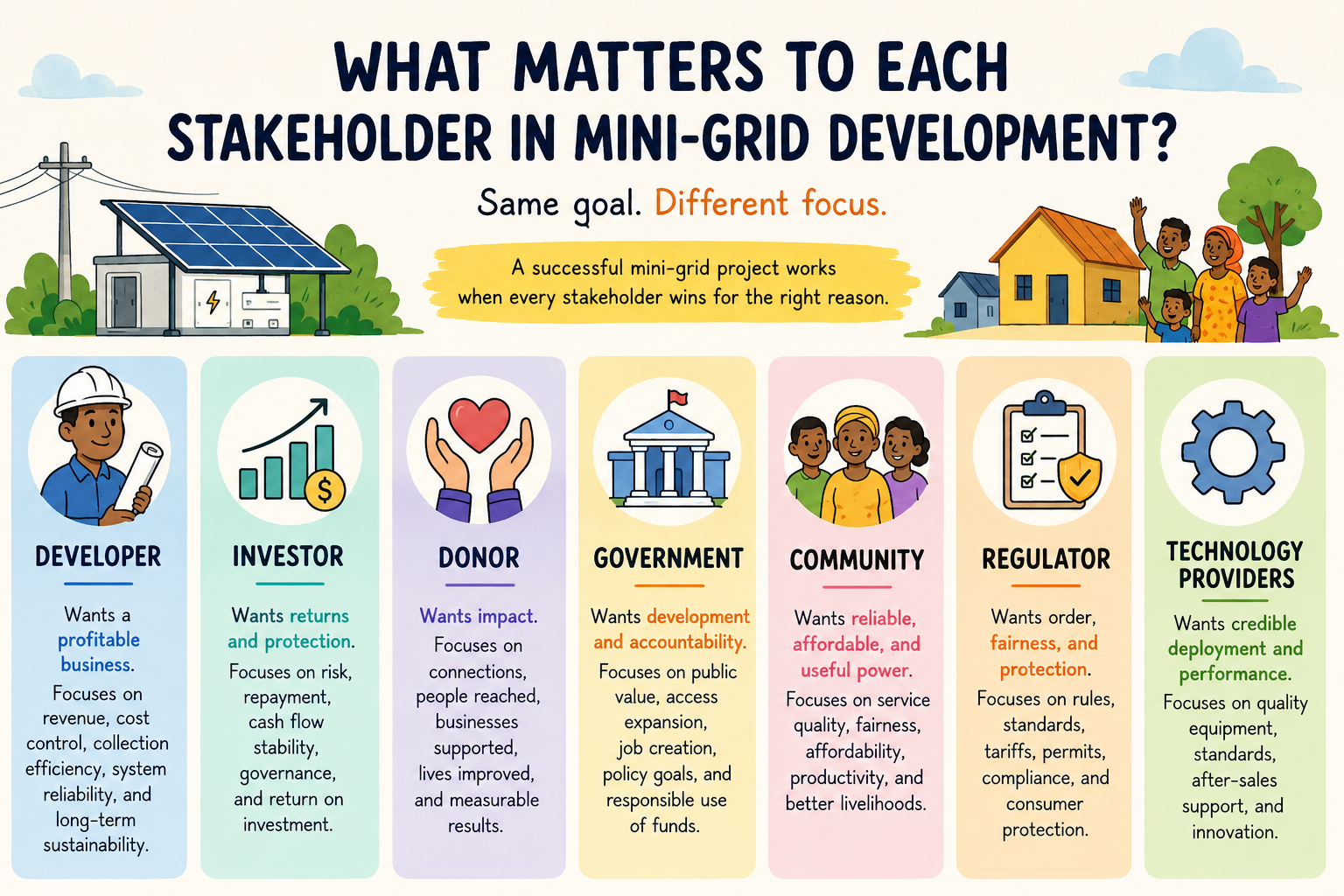
Mini-grid projects succeed when every stakeholder sees value, but not always in the same way. Developers focus on profitability, investors on returns and risk, donors on measurable impact, government on development and accountability, and communities on reliable, affordable power. This article explores why understanding these different priorities is critical for site selection, financing, project design, and long-term sustainability.
One of the biggest lessons I have learnt in my ten-year journey in the mini-grid space is that a mini-grid is not a one-man show. That sounds simple, almost obvious, but it is one of those lessons that only becomes real when you have seen projects move from concept note to site assessment, from financial model to engineering design, from grant application to commissioning, and then from commissioning to the hard, everyday work of keeping customers connected and paying.
In theory, everyone around a mini-grid project wants the same thing: electricity access. The developer wants to build. The investor wants the project to succeed. The donor wants impact. The government wants development. The community wants reliable power. On paper, everybody is facing the same direction. But in practice, what matters to each stakeholder is different.
And if you do not understand those differences early enough, you may design a project that looks good to you but does not speak to the people whose support you need. You may select a site that excites the developer but does not excite a donor. You may build a project that looks impactful on paper but cannot repay debt. You may chase connection numbers and forget consumption. Or you may chase productive users and forget that public-sector and donor-backed programmes often need scale, inclusion, and reportable impact.
That is why this lesson matters: before you build, before you raise money, before you choose a site, before you speak to the community, you need to ask one question clearly: What matters to each stakeholder?
This article builds on my earlier lesson that mini-grids are not a one-man show. In that lesson, I explained that a developer cannot succeed in isolation. The developer needs investors, government, donors, regulators, communities, technology providers, and sometimes distribution companies. But in this lesson, I want to go a step further: it is not enough to know who the stakeholders are. You must understand what each of them is looking for.
The developer wants profitability — because the mini-grid is a business
Let me start with the developer. The developer is usually the primary driver of the project. They identify the site, carry out the demand assessment, engage the community, prepare the technical design, build the financial model, raise funds, procure equipment, manage construction, operate the site, collect revenue, maintain the system, and take the blame when things go wrong.
So, yes, the developer may be passionate about energy access. Yes, the developer may care about climate impact. Yes, the developer may be genuinely committed to rural development. But at the heart of it, the mini-grid is still a business. And because it is a business, what matters most to the developer is profitability.
The developer needs to recover the money already invested. The developer needs to repay loans. The developer needs to pay staff. The developer needs to replace batteries in the future. The developer needs to maintain the network. The developer needs to keep the system running when panels degrade, inverters fail, meters misbehave, customers default, and demand does not grow exactly as projected. This is why I always say that the fact that a community does not have electricity does not automatically make it a good mini-grid site. That is a hard truth in the sector.
A site can have poor access to electricity and still not be commercially viable. A community can have a large population and still not consume enough energy to sustain the system. A village can have many households, but if the ability and willingness to pay are weak, the project will struggle. Another site may have fewer people but stronger commercial activity, a telecom tower, agro-processing, welding, cold storage, irrigation, schools, health centres, or other productive loads that create predictable consumption.
For the developer, consumption matters. Revenue matters. Tariff recovery matters. Load growth matters. Collection efficiency matters. Downtime matters. System losses matter. Battery replacement costs matter. The financial model is not just an Excel sheet; it is the survival map of the project.
This is also why productive users and anchor loads are so important. The International Energy Agency notes that productive users, especially anchor loads, can help stabilize mini-grid revenue and make projects more commercially viable. It also notes that businesses consume nearly three times more energy per connection than households, while public institutions such as schools and healthcare centres can consume six times more.
That point confirms what many developers already know from experience: household connections may give you the numbers, but productive loads often give you the revenue backbone. A thousand households may look beautiful in a report, but if many of them only use lights, phone charging, radios, and small appliances, the revenue may not be enough to carry the economics of the system. On the other hand, a few productive users can change the profile of the site significantly.
That is why the developer is always asking: where is the demand? Who will consume during the day? Who will consume at night? Who can pay consistently? What happens after the grant is gone? What happens after year two, year five, year seven? For the developer, impact is important — but profitability keeps the project alive.
The investor wants returns — and protection
The investor also wants the project to succeed, but the investor looks at the project differently. The developer is in the trenches. The investor is looking at the risk-return profile.
An investor is asking: if I put money into this project, how do I get it back? At what return? Over what period? What is the repayment structure? What is the collateral? What is the project’s cash flow? What are the risks? What happens if demand is lower than expected? What happens if the grid arrives? What happens if the exchange rate changes? What happens if tariffs become politically sensitive? What happens if the developer cannot collect revenue?
This is where the difference between the developer and investor becomes clear. Both want money, but the pressure is not the same. For the developer, profitability is tied to daily survival. If the site underperforms, the developer feels it immediately. Salaries still have to be paid. Batteries still have to be replaced. The community still expects power. Lenders still expect repayment.
For the investor, the terms are usually defined before the money is released. If it is debt, the investor expects repayment with interest. If it is equity, the investor expects value creation and future returns. If it is a blended structure, the investor still wants to know that the project has enough commercial discipline to survive beyond subsidies.
This is why investors are not moved by beautiful stories alone. They need data. They need credible demand assessment. They need a realistic financial model. They need sensitivity analysis. They need clear assumptions around load growth, tariff, CAPEX, OPEX, collection efficiency, system losses, battery replacement, diesel backup if applicable, and regulatory risk.
This is also why grants can improve the investability of mini-grid projects. The World Bank’s Nigeria Electrification Project appraisal document explained that mini-grid deployment was constrained by high upfront capital costs and the cost of identifying viable sites; the project therefore included mechanisms such as minimum subsidy tenders and performance-based grants to improve viability and attract private developers.
The investor may not be the one negotiating with the community chief or solving meter complaints, but the investor cares deeply that those things do not become risks that swallow repayment. So what matters to the investor? Returns. Risk mitigation. Repayment confidence. Governance. Technical quality. Regulatory protection. A credible developer. A realistic site. A financial model that survives stress. In simple terms, the investor is asking: will this project pay me back without stories?
Donors want impact — and impact must be reportable
Now let us talk about donors. Donors, NGOs, development agencies, and philanthropic funders approach mini-grid projects differently. They are not primarily coming in to earn interest. They are not necessarily trying to own the asset. Their main concern is impact.
They want to know how many people were connected. How many households gained access to electricity. How many MSMEs were powered. How many women-led businesses benefited. How many schools or health centres improved service delivery. How much diesel generation was displaced. How much CO₂ emission was avoided. How many jobs were created. How much productive activity was unlocked.
This is why numbers matter so much in donor-funded programmes. A donor needs to report back to its own funders, board, government, taxpayers, or development partners. It needs to say: this is the money we spent, and this is the result it produced. This is where the developer must be wise.
A site that has only 40 or 50 productive users may look attractive from a revenue perspective, but it may not be enough to satisfy a donor that wants broad access impact. The donor wants numbers that tell a development story. They want to say, “We electrified 1,000 households,” or “We provided reliable power to thousands of people,” or “We supported hundreds of MSMEs.”
That does not mean donors do not care about sustainability. Good donors increasingly care about long-term performance. But their primary language is impact. You see this clearly in Nigeria’s major energy access programmes. The World Bank said the Nigeria Electrification Project supported 125 mini-grids and the sale of over one million solar home systems, enabling more than 5.5 million Nigerians to gain access to electricity and creating over 5,000 private-sector local green jobs.
That is the kind of result a donor or public development programme can report. The same logic continues under DARES — the Distributed Access through Renewable Energy Scale-up project. REA describes DARES as a $750 million World Bank-funded initiative designed to provide new or improved electricity access to more than 17.5 million Nigerians, with targets including over 1,225 mini-grids, 465 MW of generation, more than 236,000 MSMEs, and over 3.2 million households to be powered.
Those targets show the donor and public-sector mindset clearly: scale, access, households, MSMEs, generation capacity, and lives impacted. But here is where my own concern comes in: impact should not end at connection.
One lesson from the sector is that it is possible to connect many customers and still not build a sustainable project. You can commission a site, connect customers, verify meters, claim subsidy, and still have a weak project three years later if consumption is low, service quality is poor, equipment quality is poor, or the system is not maintained properly.
That is why I believe result-based financing should increasingly reward long-term results, not just short-term connections. To be fair, this thinking has already started entering programme design. Under the Nigeria Electrification Project, performance-based grants were designed around new customer connections, with grant support intended to bridge affordability gaps and support commercially viable mini-grid projects. The appraisal document also refers to benchmark subsidy levels and notes that grants should not exceed 50% of total project capital cost.
But the future of result-based financing should go further. It should ask: are customers still consuming after two years? Is the system reliable? What is the downtime? Are productive users growing? Are the batteries still healthy? Is the tariff still affordable? Is the community satisfied? Is the project financially stable?
Because true impact is not “we connected people.” True impact is “people are still receiving quality power, using it productively, and improving their lives years after commissioning.”
Government wants development, accountability, and political confidence
Government is another major stakeholder, and government’s interest is sometimes misunderstood. Government may provide grants. Government may support land access. Government may create enabling policies. Government may help with community entry. Government may provide tax incentives or import-duty relief. Government may support security and local coordination. Government may help ensure that a proposed mini-grid site is not already in the near-term grid extension plan.
But government is not usually coming into the project to share profit with the developer. Government’s main concern is public value. Government wants to say: we used public resources to improve lives. We electrified communities. We supported businesses. We created jobs. We reduced generator dependence. We improved rural productivity. We delivered development.
That is why, for government, the story must be defensible. If taxpayers’ money, public loans, or sovereign-backed development finance is involved, then the result must be reportable. Government officials need numbers. They need evidence. They need communities they can point to. They need projects that do not embarrass them after commissioning.
This is also where regulation becomes important. In Nigeria, the Mini-Grid Regulations 2023 provide the formal regulatory framework for mini-grid development. Regulation is not just a bottleneck; when properly designed, it protects developers, communities, investors, and the wider sector.
I have said this before: regulatory frameworks can feel frustrating to developers, especially when the approval process is slow or unclear. But a good regulatory framework can also protect the project. It can define tariff rules, permit conditions, community agreements, technical standards, what happens when the main grid arrives, and how disputes are handled.
That matters because one of the biggest risks to a mini-grid developer is policy uncertainty. You do not want to build a project only to discover that the main grid will arrive shortly after commissioning, or that the community agreement is weak, or that the tariff is challenged, or that the asset has no protection.
So, for government, what matters? Access. Public impact. Accountability. Development outcomes. Political credibility. Sector order. Consumer protection. Long-term sustainability. Government wants the project to work — but it also wants the project to make sense within a wider development and policy agenda.
The community wants reliable, affordable, useful power
The community is sometimes treated as a beneficiary, but that is too small a word. The community is not just a recipient. The community is a stakeholder.
Without community acceptance, the project will struggle. Without trust, collections will suffer. Without proper sensitization, people may reject tariffs, misunderstand the service, bypass meters, or compare mini-grid tariffs unfairly with subsidized grid tariffs. Without productive use support, demand may remain too low. Without reliable service, customers will lose confidence.
The community wants power that works. Not power that appears only during commissioning. Not power that is available when the donor visits. Not power that fails when the freezer is full. Not power that cannot support businesses. Not power that is too expensive for the income profile of the area. The community wants reliability, affordability, fairness, responsiveness, and usefulness.
This is why demand assessment must go beyond counting houses. You need to understand livelihoods. What do people do in the day? What do they do at night? Are there welders, grain millers, tailors, barbers, cold-room operators, pharmacies, schools, clinics, irrigation users, agro-processors, religious centres, markets, telecom towers, or water schemes? What appliances do they own? What appliances would they buy if power became reliable? What do they currently spend on petrol, diesel, kerosene, candles, phone charging, or generator rental?
A mini-grid succeeds when electricity becomes part of the economic life of the community. That is why productive-use stimulation should not be an afterthought. If people only use electricity for basic lighting, the development impact is limited and the project economics may remain weak. But when power supports income-generating activity, the community benefits and the developer benefits. That is the sweet spot.
The financing mix determines what must be prioritized
One of the most important points in my original thought is that the financing mix changes the pressure on the project. Let us say a project is financed with 50% debt, 25% equity, and 25% grant. In that case, 75% of the money has strong commercial pressure attached to it. The debt must be repaid. The equity must earn returns. The grant helps, but it does not remove the need for strong project economics. For this kind of project, the developer must be very serious about productive users, anchor loads, collection efficiency, and revenue certainty.
Now flip the structure. Suppose debt is 25%, equity is 15%, donor grant is 40%, and government grant is 20%. In that case, 60% of the project financing is impact-driven. The business case still matters — very much — but the project must also satisfy the reporting and development objectives of the donors and government. You cannot ignore connection numbers, inclusion, households, public institutions, and visible community impact.
This is the balancing act. A developer must understand who is carrying the project financially and what each funder needs to see. If debt dominates the capital stack, revenue resilience becomes even more urgent. If grants dominate the capital stack, impact reporting becomes even more important. If equity dominates, long-term value creation matters. If public funding is involved, accountability and visibility matter.
But none of these should cancel the others. A grant-heavy project still needs commercial discipline. A debt-heavy project still needs social impact. An investor-backed project still needs community trust. A government-supported project still needs technical quality. The mistake is to think one stakeholder’s priority is the only priority. The art is to design a project where each stakeholder can see what matters to them without destroying what matters to others.
Site selection is really stakeholder alignment
This is why site selection is not just a technical exercise. It is stakeholder alignment. When selecting a site, you are not only asking, “Is there no power here?” You are asking: can this site generate enough revenue for the developer? Can this site produce enough stable cash flow to satisfy investors? Can this site deliver enough connections and social impact to satisfy donors? Can this site support government’s development priorities? Can this site serve the community reliably and affordably? Can this site survive beyond commissioning? Can this site still make sense if demand grows slowly, diesel prices change, battery replacement costs rise, or the grid arrives nearby?
The World Bank’s work around the Nigeria Electrification Project also recognized the importance of geospatial analysis, cost benchmarking, technical standards, developer-financier matchmaking, and analytics in mini-grid preparation and implementation. That matters because good site selection is not guesswork. It requires data, field intelligence, regulatory awareness, community understanding, and financial discipline.
The wrong site can punish everybody. The developer loses money. The investor loses confidence. The donor reports weak sustainability. Government faces criticism. The community becomes disappointed. The sector’s credibility suffers.
But the right site can create a beautiful alignment. The developer earns. The investor gets repaid. The donor reports impact. Government shows development. The community receives reliable power. Businesses grow. Diesel use reduces. Jobs emerge. The project becomes a reference point. That is the kind of site every mini-grid developer should be looking for.
The real lesson: everybody must win, but not for the same reason
After ten years in this space, one thing has become clearer to me: the goal may look the same, but the motivation is different. The developer wants a profitable business. The investor wants a protected return. The donor wants measurable impact. The government wants development and accountability. The community wants reliable and affordable power that improves daily life. The regulator wants order, fairness, and protection. The technology provider wants bankable deployment and long-term performance. The distribution company, where relevant, wants clarity around territory, grid arrival, interconnection, and commercial boundaries.
These interests are not enemies. In fact, when properly understood, they can strengthen the project. The problem starts when a developer assumes that what matters to them should automatically matter to everyone else in the same way. That is rarely true.
If you want donor support, speak the language of impact. If you want investor support, speak the language of risk and return. If you want government support, speak the language of public value and accountability. If you want community acceptance, speak the language of trust, reliability, and usefulness. If you want your own business to survive, speak the language of revenue, cost control, technical quality, and long-term operations.
A successful mini-grid project is not just a power system. It is a negotiated balance of interests. And the earlier a developer understands that, the better the project becomes.
Because in the end, mini-grid development is not only about installing panels, batteries, meters, poles, and wires. It is about building a structure where every stakeholder can look at the same project and say: “This works for me.” That is when the project has a real chance of lasting.