The Minigrid Business
A practical reflection on why minigrids must be treated as long-term energy service businesses — not charity projects — if they are to deliver lasting impact.
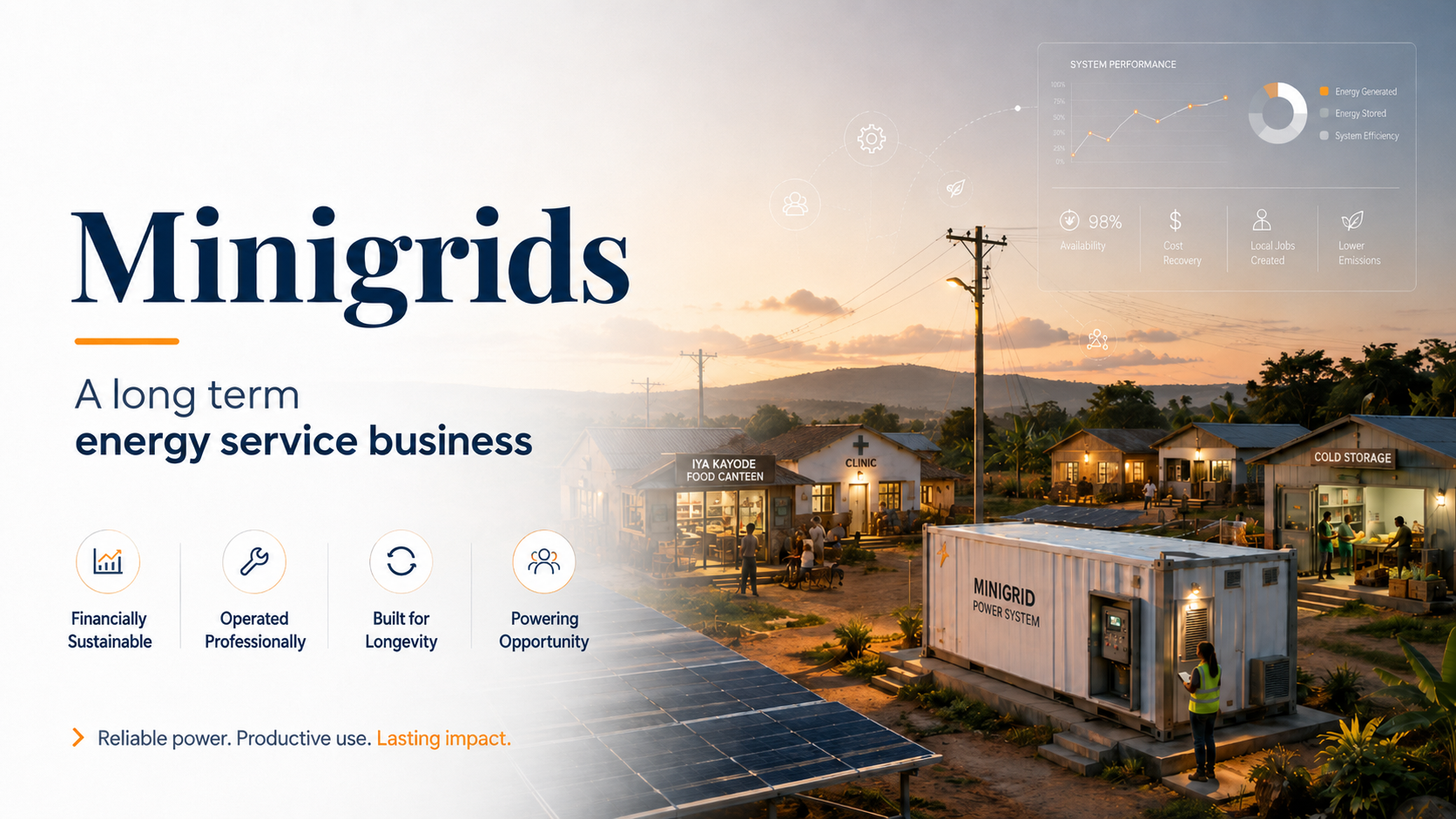
After 10 years of working in the distributed renewable energy sector, especially around minigrids, one lesson has become very clear to me: A minigrid is not a charitable act. It is a long-term energy service business.
That statement may sound uncomfortable at first, especially because many minigrids are built in underserved rural communities where the development need is obvious and often characterized by poverty with limited exposure. In many of these communities, electricity access is not just a convenience; it can determine whether children study at night, businesses stay open longer, clinics preserve vaccines, and households move away from expensive or unsafe energy alternatives. So yes, minigrids can create social impact. They can improve livelihoods. They can support local enterprise. They can contribute to community development. However, goodwill alone does not keep a power system running.
A minigrid needs more than compassion. It needs an operator, a tariff structure, a maintenance plan, a customer management system, revenue collection, technical support, spare parts, replacement planning, and a clear understanding of demand. Without these, the project may work for a while, but it will struggle to last.
This is why governments, donors, developers, and charities rarely approach minigrids as simple “give-back” projects, regardless of the economic circumstance of the people served. Even where grants or subsidies are involved, there is still a need for an operating model. Someone must manage the system. Someone must maintain it. Someone must respond when there is a fault. Someone must replace batteries, inverters, meters, cables, and other components when they fail or reach end of life. In other words, anything that lasts must be built on a self-sustaining system.
The same logic applies to the Sustainable Development Goals. For instance, SDG 1, “No Poverty”, cannot be achieved by isolated acts of generosity alone. It requires self-sustaining systems: education, healthcare, productive employment, financial inclusion, infrastructure, and economic opportunity. In the same way, SDG 7 is not simply about installing energy assets. It is about ensuring access to affordable, reliable, sustainable, and modern energy for all. The key word is important: affordable, not free. That distinction matters.
If energy is free but unreliable, the community still suffers. If energy is subsidized but poorly maintained, the system eventually collapses. If energy is installed without a revenue model, the first major component failure may become the beginning of the end.
A minigrid, therefore, must be understood as a business — not in the narrow sense of profit maximization at all costs, but in the practical sense of sustainability. It must generate enough value to cover operating costs, maintenance, customer service, losses, future replacement costs, and a reasonable return for the people and institutions taking the risk.
This understanding should shape every decision in the project lifecycle. It should influence the site you choose. It should influence the customer mix you target. It should influence how you treat productive users, anchor customers, households, small businesses, and public institutions. It should influence your financial model, your technical design, your operations plan, and even your community engagement strategy.
A site with 300 households may look attractive on paper, but if most customers only need basic lighting and phone charging, the project economics may be weak. A smaller site with productive users — welders, mills, cold storage operators, agro-processors, commercial clusters, telecom towers, or public institutions — may offer a stronger pathway to sustainability. This is one of the realities that separates minigrid planning from minigrid optimism. The sector needs both impact and discipline.
According to the International Energy Agency, around 600 million people in sub-Saharan Africa still lacked access to electricity as of 2024. The World Bank and ESMAP have also estimated that solar minigrids could connect nearly 490 million people globally by 2030 if the right policies, financing, and delivery models are in place. That is a massive opportunity. But it is also a massive operational challenge.
The challenge is not only to build systems. The challenge is to keep them alive. That is where the real work begins. Even when a minigrid is built with grant support, the project does not become cost-free. There will still be operating expenses. There will still be staff costs. There will still be contractor costs. There will still be maintenance costs. There will still be battery and inverter replacement costs. There will still be collection losses, inflation, exchange-rate exposure, vandalism risks, unexpected outages, and customer disputes. Reliable power comes at a cost.
Even the main grid, which is not always reliable in many contexts, is not free. So we should not expect a decentralized grid, serving remote communities with smaller demand profiles and higher logistics costs, to survive without a serious commercial and operational structure.
This is a lesson I learned early in my career. Before I fully understood the minigrid sector, I was deeply moved by the reality that some rural communities had never experienced grid power and might not be connected for decades. I imagined what electricity could mean for such communities: children reading at night, households charging phones locally, small businesses staying open longer, and people experiencing a new sense of possibility.
That compassion pushed me to start with what I could manage at the time: a standalone solar installation for basic lighting and phone charging. It was not a minigrid, but it was a small attempt to solve a real problem. At the time, I wasn’t thinking about the long term sustainability of the system. What mattered to me was to create an impact (which is important).
For a while, it worked. Then, a little over a year after installation, the battery needed replacement. Minor maintenance was also required to keep the system running properly but there was no one available to carry out those repairs. When the battery was due for replacement, there was no fund available to replace the battery, talk less of a system upgrade. After all, the system was installed as a goodwill service to the community, with no intention to make money from it. That was the moment the lesson became real to me. If a simple standalone solar system could not sustain itself, then a minigrid — with higher technical complexity, more customers, larger assets, more operational demands, and greater financial exposure — certainly could not.
It sounds obvious now, but it is a lesson that is still sometimes overlooked. We cannot build lasting energy access on sentiment alone. Compassion may start the conversation, but structure keeps the lights on. For minigrids to deliver long-term impact, we must treat them as serious infrastructure and serious businesses. That means better site selection, realistic demand projections, proper tariff design, strong community engagement, reliable operations, planned maintenance, data-driven monitoring, and financial models that account for the true cost of service.
The goal is not to remove impact from the conversation. The goal is to protect impact from failure. Because in the end, a minigrid that stops working after a few years does not serve the community, the developer, the donor, or the government. The real measure of success is not installation. It is not even in the number of households or businesses connected to the grid. It is not in the number of public institutions electrified. It is in the sustainability of what was built over time and sustainability requires a system.