Regulatory Frameworks Matter
Are regulatory frameworks slowing down mini-grid development, or are they protecting it? Drawing from 10 years of experience in the DRE sector, this article explores how regulations safeguard investments, protect consumers, align stakeholders, and create the confidence needed for long-term project success.
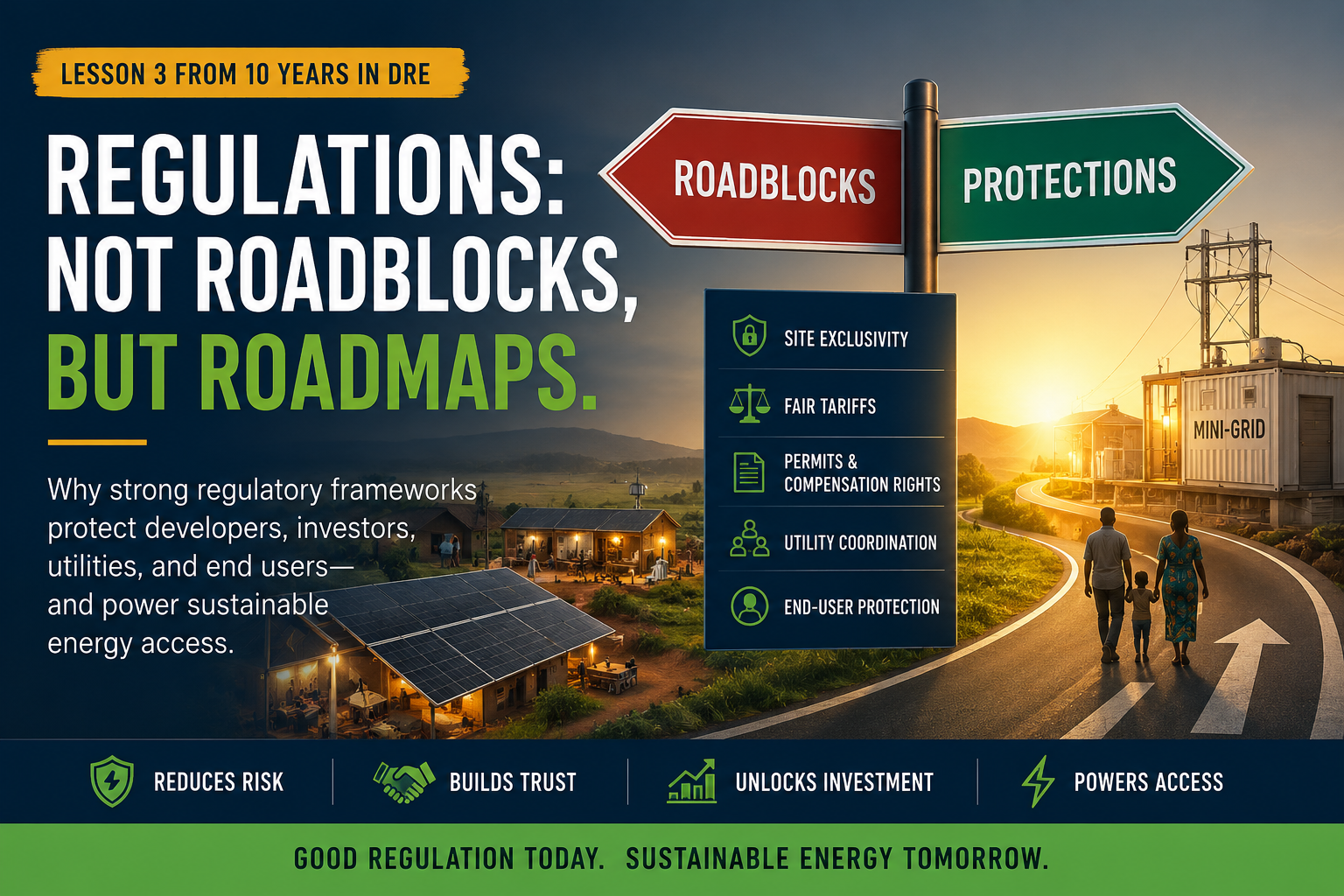
Role of Regulatory Frameworks in Mini-Grid Development
When I started my journey in the distributed renewable energy (DRE) sector over a decade ago, there was one thing I struggled to appreciate. Regulations! At the time, they felt like obstacles.
Before developing a mini-grid, there were permits to obtain, utility clearances to secure, tariffs to justify, community agreements to sign, and countless requirements to satisfy. It often felt as though every step forward came with another form, another approval, or another rule.
As a young professional focused on bringing electricity to underserved communities, I remember wondering: "Why is this so complicated? If the goal is simply to provide power to communities that need it, why all the bureaucracy?"
Ten years later, my perspective is completely different. Today, I have come to see regulatory frameworks not as barriers to progress, but as the foundations upon which sustainable energy markets are built.
The question is no longer whether regulations matter.
The real question is: Are regulatory frameworks bottlenecks or protections?
From my experience, they are overwhelmingly protections.
Understanding What Regulations Really Are
At their core, regulatory frameworks are simply a set of rules, requirements, and boundaries established to govern how a sector operates. In the power sector, these rules determine what is permissible, what is prohibited, who has rights, who has obligations, and how disputes are resolved.
Just as laws provide structure to society, regulations provide structure to markets. Without them, investments become uncertain, stakeholder conflicts increase, and long-term sustainability becomes difficult. This is particularly important in the DRE sector (especially for Minigrids) because the ecosystem involves far more stakeholders than many people realize.
The alternative energy space is not just about a developer and a community.
It involves:
- Developers
- Investors
- Distribution Companies (DISCOs)
- Transmission Companies (TRANSCOs)
- Generation Companies (GENCOs)
- Regulators
- Local communities
- End users
Each stakeholder has legitimate interests that need protection.
The role of regulation is to balance those interests fairly.
The Moment My Perspective Changed
One of my early responsibilities involved scouting potential mini-grid communities. After identifying a promising site, one of the first activities was signing an exclusivity agreement with the host community. At the time, I viewed it as another administrative hurdle. Why not simply start the project?
But then I understood the reason. Imagine investing months in site identification, community engagement, demand assessment, engineering studies, and financial modeling.
Then another developer arrives, sees the opportunity, and begins developing the same site.
Without an enforceable framework, who owns the right to proceed?
Who gets protected?
Who absorbs the loss?
This is exactly why regulations often recognize site exclusivity arrangements. In Nigeria, mini-grid regulations provide mechanisms that allow developers to secure a defined exclusivity period while they conduct early-stage project development activities. This reduces the risk of "developer poaching" and protects the resources already invested in project preparation.
What once looked like bureaucracy suddenly looked like investment protection.
Regulation Protects More Than Developers
One mistake people often make is assuming that regulations exist solely to control developers.
In reality, regulations protect everyone.
Protecting Developers and Investors
Investors are not merely funding the construction of infrastructure.
They are investing in the expectation that the project will operate for years and generate predictable returns without future encroachment. One of the first things serious investors assess when entering a new market is the quality of its regulatory environment. Can permits be enforced? Are tariffs recognized? What happens if the main grid arrives? How are disputes resolved? Can investments be compensated?
The answers to these questions determine whether capital flows into a market or stays away.
A strong regulatory framework reduces uncertainty, which in turn improves investor confidence.
Protecting Distribution Utilities
Many developers enter the sector assuming that mini-grids operate independently of utilities. The reality is more nuanced. In many countries, including Nigeria, Distribution Companies maintain concession rights and have legally recognized responsibilities regarding network expansion and service delivery.
Understanding these rights early helps developers avoid unnecessary conflicts and project delays. Recent Nigerian regulations, for example, require coordination between developers and DISCOs and establish procedures for obtaining confirmation or consent before project development proceeds in certain areas. These requirements may seem cumbersome initially, but they prevent much bigger problems later.
Protecting End Users
Perhaps most importantly, regulations protect consumers.
One area where this becomes obvious is tariff setting.
Mini-grid tariffs are often higher than national grid tariffs because mini-grids typically do not benefit from the same level of subsidy enjoyed by centralized power systems.
Without regulation, a developer could theoretically charge whatever price they choose.
Conversely, without regulatory support, governments or political actors could suppress tariffs below sustainable levels, making projects financially unviable.
Effective regulation creates a middle ground.
Nigeria's mini-grid framework provides mechanisms for cost-reflective tariffs while retaining regulatory oversight to ensure fairness and consumer protection. It also allows tariff agreements with communities under defined conditions while preserving the regulator's ability to intervene where necessary.
The result is a better balance between affordability and sustainability.
The Regulation That Developers Appreciate Most
If there is one area where regulations demonstrate their value most clearly, it is grid arrival.
This is a concern every mini-grid developer eventually faces.
What happens if the utility grid reaches a community after a mini-grid developer has already invested significant capital?
Without regulation, years of investment could disappear overnight.
Fortunately, many modern mini-grid frameworks address this issue directly.
Nigeria's mini-grid regulations establish compensation mechanisms and transition pathways when a DISCO extends its network into a permitted mini-grid area. Depending on the circumstances, developers may receive compensation, transfer assets, or transition into interconnected operations. These provisions provide a level of certainty that investors actively seek.
Again, what initially appears to be paperwork is actually risk mitigation.
Not Every Country Gets It Right
One lesson I have learned while observing different energy markets is that regulations are not created equal.
Some countries have dedicated mini-grid regulations that clearly define responsibilities, tariffs, compensation rights, and permitting procedures.
Others simply apply traditional utility regulations to mini-grids without recognizing the unique realities of decentralized energy projects. The consequences can be severe.
Where cost-reflective tariffs are not permitted, project economics can become unworkable from the outset. Where compensation rights are unclear, investor confidence declines.
Where permitting processes are uncertain, development timelines stretch indefinitely.
This is why regulatory diligence should be one of the first activities undertaken when entering a new market. Before evaluating solar resources, demand forecasts, or system designs, developers should first understand the rules of the game.
My Biggest Takeaway
After ten years in the DRE sector, I have come to appreciate a simple truth: The strongest projects are not necessarily those with the best technology. They are the ones built on the strongest foundations and one of those foundations is regulation.
Though regulations can feel slow, compliance requires effort and processes can be frustrating, regulatory frameworks create something far more valuable than speed when properly designed and fairly enforced. They create Trust and Confidence. Trust for investors. Trust for developers. Trust for utilities. Trust for communities. Trust for end users.
In an industry where projects are expected to operate for 15 to 25 years, trust is not a luxury. It is a necessity. So whenever I hear developers describe regulations as obstacles, I often smile because I remember thinking exactly the same thing ten years ago.
Today, I see them differently. Not as bottlenecks but as one of the most important forms of protection a developer can have in a sector where long-term sustainability matters more than short-term speed. The protection regulations provide are worth far more than most people realize.