Mini-Grids Are Not a One-Man Show
Mini-grids are not solo projects or charity efforts; they are long-term energy service businesses that require collaboration. This post explains how developers, government, investors, donors, and communities each play a critical role in making mini-grid projects bankable, scalable, and sustainable.
Mini-Grids Are Not a One-Man Show
In my previous post, I shared one of the earliest lessons I learned in the distributed renewable energy sector: a mini-grid is not charity. It is a long-term energy service business. That lesson came from experience, not theory.
I had started with a simple standalone solar installation in a rural community, driven mostly by compassion. I had seen communities where electricity was not just unreliable, but completely absent. Children studied with weak lamps. Households charged phones far away. Small businesses closed early. People had adjusted their lives around darkness in a way that made electricity feel less like infrastructure and more like a miracle.
At the time, I wanted to help. I wanted to do something practical. So I started with what was possible: a small standalone solar system for basic lighting and phone charging. For a while, it worked. Then, a little over a year later, the battery needed replacement. Some minor maintenance was also required. The system had created value, but there was no structure to sustain it. No proper revenue model. No maintenance fund. No long-term replacement plan. No operator with the responsibility and resources to keep it alive. That was when the lesson became real to me: impact is not sustainable unless it is supported by a system.
In this second post, I want to build on that lesson with another one that became even clearer as I moved deeper into proper mini-grid development: The mini-grid business is not a one-man show. That may sound obvious, but it is easy to underestimate, especially for project developers who are about to venture into minigrids.
There is something attractive about sole ownership. Many developers naturally want control. You identify the opportunity, raise the money, build the asset, serve the community, collect the revenue, and grow the business. On paper, that sounds clean. In reality, mini-grids are far more complex.
A mini-grid sits at the intersection of energy, finance, community development, government regulation, land access, engineering, construction, local politics, customer behaviour, and long-term operations. No single party has complete control over all of these. Not the developer. Not the government. Not the investor. Not the donor.
Everyone has a role to play, and when one stakeholder is missing or weak, the project feels it.
The Developer Carries the Vision, But Not the Whole Burden
The developer is usually the primary driver of the project. The developer identifies the site, assesses the community, studies demand, engages local leaders, signs MOUs, develops the financial model, sources capital, manages engineering and procurement, oversees construction, and eventually takes responsibility for operations and maintenance. That is already a lot.
In many cases, the developer is the one who first sees the opportunity. They are the ones who visit the community, count the households, observe the commercial activities, speak with business owners, estimate demand, and imagine what the community could become with reliable power. But vision is not enough.
The developer may understand the technical design. They may build a strong financial model. They may even have a good relationship with the community. But the developer still needs other stakeholders to make the project bankable, legal, secure, affordable, and scalable.
A developer can design a mini-grid, but cannot single-handedly create the enabling environment that allows that mini-grid to thrive. That is where government comes in.
Government Support Is Not Optional
In many mini-grid conversations, government is sometimes discussed only in terms of regulation. But in practice, government involvement goes much further than that. Government support can determine whether a project moves smoothly or gets stuck before it even begins.
Who owns the land? Who has the authority to approve its use? What permits are required? Are there local rules that are not written anywhere but are still powerful enough to delay a project? Is the area secure enough for contractors and equipment? Is there an access road? Is there a possibility that the national grid will arrive soon and displace the mini-grid’s business case? Are there tax policies or import duties that make equipment unnecessarily expensive?
These questions matter because they affect the project before the first panel is installed.
A mini-grid may look financially viable in a spreadsheet, but if land access becomes complicated, if local approvals are delayed, if import tariffs push costs beyond the original budget, or if the grid is extended to the same community soon after commissioning, the economics can change completely. This is one of the realities that financial models often struggle to capture.
Months before execution, a model may look clean. The capex is estimated. The tariff is assumed. The number of customers is projected. The grant is expected. The loan repayment is calculated. The payback period looks reasonable. Then execution begins.
A local condition emerges. A permit takes longer than expected. A road becomes difficult during the rainy season. A land issue delays installation. A stakeholder who was not considered suddenly becomes important. An import-related cost changes the procurement budget. A community concern requires more engagement than planned.
These are not always signs of poor planning. Sometimes, they are simply the realities of building infrastructure in underserved and often remote areas. This is why government support is not just a “nice to have.” It is part of the project’s risk management structure.
When government creates a regulatory-friendly environment, provides clarity around permits, supports land access, offers tax holidays or import-duty relief, helps with security concerns, and gives visibility on grid extension plans, the project becomes easier to finance and operate. Without that support, the developer carries too much uncertainty. And uncertainty is expensive.
Investors and Donors Do More Than Provide Money
The next group of stakeholders is investors and donors.
Their role is often discussed in financial terms, and rightly so. Mini-grid projects are capital-intensive. The cost of solar panels, batteries, inverters, meters, distribution lines, logistics, civil works, installation, and commissioning can be significant. In many rural communities, customer demand is also modest at the beginning, which means revenue may grow slowly. This is why a viable mini-grid typically requires a combination of three financing components: Equity. Debt. Grants.
Equity is the developer’s own capital or the capital provided by equity investors. It shows commitment. It gives the project a foundation. But relying only on equity is risky. No wise developer should put all available funds into one project, especially in a sector where demand, regulation, foreign exchange, logistics, and community conditions can all shift.
Debt is another important component. Loans can help developers finance construction and scale faster. But debt has its own discipline. It must be repaid, usually with interest, whether the project performs exactly as expected or not.
This becomes even more delicate when the loan is denominated in foreign currency while revenue is collected in local currency. If a developer borrows in dollars but earns in naira, cedis, shillings, francs, or another local currency, exchange-rate movements can quietly damage the business model. A project that looked profitable at one exchange rate can become stressed at another.
Then there are grants. In many mini-grid markets, grants are not just helpful; they are often critical to viability. They help close the gap between what it costs to build reliable infrastructure and what rural customers can realistically afford to pay.
Many grant programmes are structured as Results-Based Financing or Performance-Based Grants. In simple terms, the developer does not just receive money because they have an idea. The grant is tied to demonstrated results, such as verified connections, commissioned systems, or performance milestones.
That structure matters. It protects public or donor funds from being spent on promises alone. It also pushes developers to deliver real connections and working systems.
But for the developer, it also means cash-flow planning must be very careful. If grant disbursement comes after results are verified, then the developer still needs enough upfront capital to build, connect customers, and survive the waiting period before reimbursement.
This is where the financing puzzle becomes very real. Equity shows commitment. Debt enables scale. Grants close the viability gap. Remove one of these, and the project can become difficult very quickly.
Without grants, breaking even on many rural mini-grid projects can be extremely hard. The cost-reflective tariff required to fully recover capital and operating costs may become too high for the community. If the tariff is set too low, the project struggles. If it is set too high, customers may not consume enough power to sustain revenue.
This is why grants are not “free money” in the casual sense. They are a tool for making socially necessary infrastructure financially possible. Of course, grant providers also have an interest in the success of the project. If a rural electrification agency, donor programme, or development partner supports a mini-grid, they are also entitled to point to the project as part of their contribution to energy access and development. That is fair. They helped make the project happen. The developer may own or operate the asset, but the story of the project is shared.
My First Real Mini-Grid Lesson
My understanding of stakeholder collaboration became much stronger in 2017, when I transitioned from small standalone solar experience into proper mini-grid project work.
I served as the on-site project manager for an 85 kWp mini-grid project. That project connected over 500 households, about 150 commercial users, and roughly 40 to 50 productive users. That experience changed the way I saw mini-grids.
Before then, it was easy to think about energy access mainly in terms of need: people need light, businesses need power, communities need development. But on site, you quickly realise that need is only one part of the equation. You have to deal with people. You have to deal with contractors. You have to deal with deadlines. You have to deal with land questions. You have to deal with government representatives. You have to deal with community expectations. You have to deal with equipment movement, installation realities, local concerns, and technical decisions that must be made quickly but carefully.
As the on-site project manager, I interacted directly with EPC contractors, community members, local leaders, and government representatives. I saw how much coordination was required just to keep the project moving.
The engineering work mattered, of course. The system had to be designed and installed properly. But the non-technical issues were just as important. Land rights had to be clear. Community expectations had to be managed. Compliance issues had to be respected. The EPC team needed access and cooperation. The project needed trust. No spreadsheet could fully capture that. A financial model may tell you whether a project should work. Field execution tells you whether it can actually work.
One of the biggest lessons from that project was that the tariff structure alone could not easily recoup the full capital investment. The customers needed electricity, yes. Many were willing to pay for better service, yes. But willingness to pay is not the same as ability to carry the full cost of infrastructure. This is where productive users became important.
Households are essential. They represent social impact and connection numbers. But productive users strengthen the economics. Welders, millers, cold storage operators, agro-processors, small manufacturers, commercial clusters, clinics, schools, and telecom sites can increase daytime demand and improve revenue stability.
A mini-grid serving only low-consumption households may struggle. A mini-grid with a strong mix of households, commercial users, and productive users has a better chance.
Still, even with productive users, the project needed the right capital structure. The tariff alone was not enough. The business needed support from a broader stakeholder ecosystem.
Collaboration Provides Natural Coverage
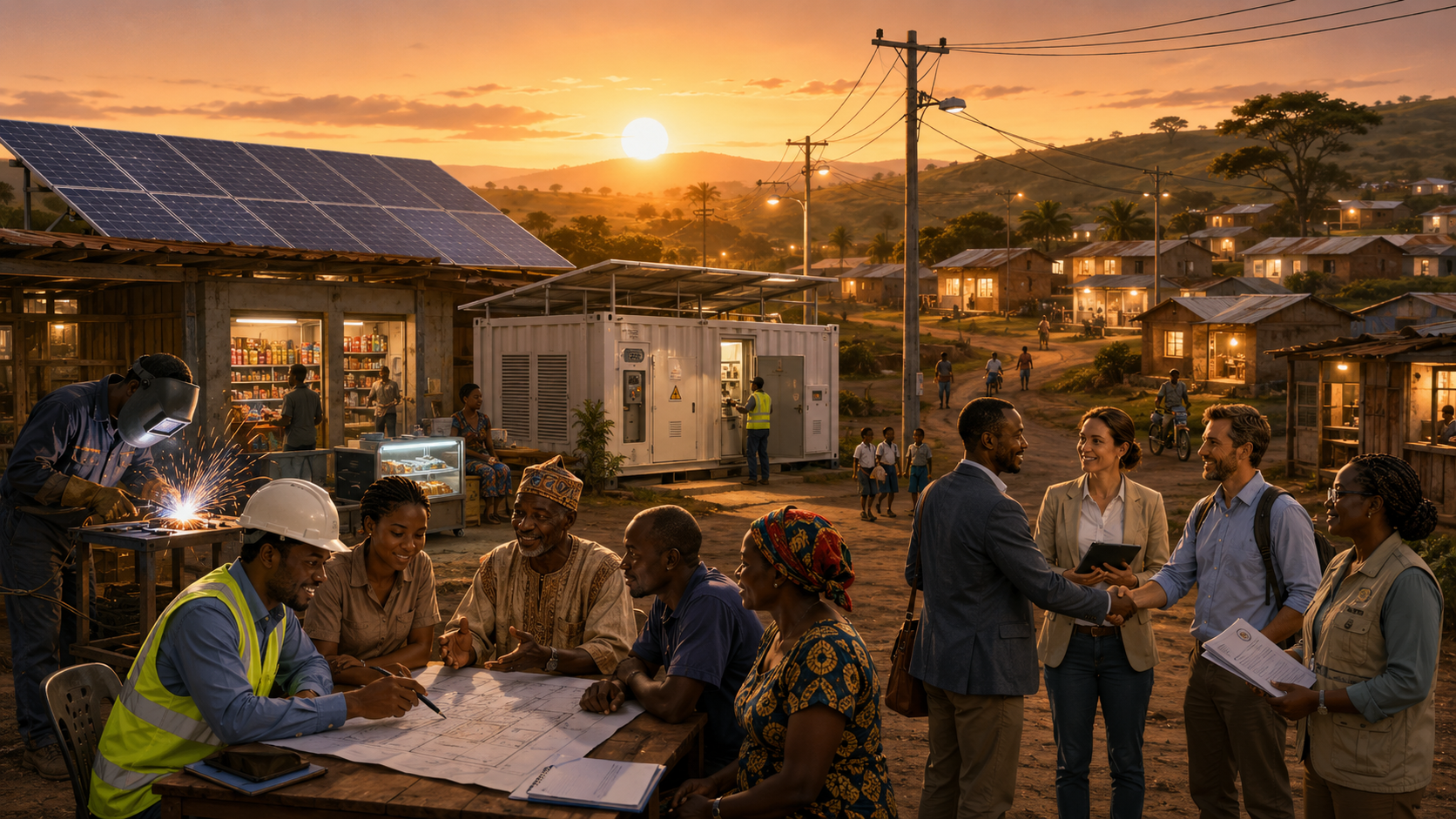
Over time, I began to see stakeholder involvement as a form of natural coverage. The developer brings initiative, technical direction, operational responsibility, and commercial discipline. The government provides legitimacy, regulatory clarity, land support, policy direction, and sometimes security or access support. Investors provide capital discipline, growth funding, and pressure for performance. Donors and public financing programmes help close the viability gap and make access affordable for communities that need power but cannot carry the full cost of infrastructure upfront. Communities provide acceptance, demand, local intelligence, and long-term partnership.
Each stakeholder covers a risk that another stakeholder cannot fully carry alone. This is important because mini-grid projects are exposed to many kinds of risk: financial risk, construction risk, demand risk, community risk, regulatory risk, foreign exchange risk, security risk, and operational risk. When stakeholders are properly aligned, those risks become easier to manage. When they are not aligned, the developer is left trying to solve everything alone. That is when projects become fragile.
Scaling Is Where the Real Business Begins
A single mini-grid can be impactful, yes. It can change a community. It can create jobs, power businesses, improve public services, and reduce dependence on diesel generators, kerosene, candles, or long-distance phone charging. But from a business perspective, one mini-grid is often not enough. The real profitability comes with scale.
Scaling across multiple communities (especially within clusters) allows a developer to spread operational costs, standardise procurement, build stronger technical teams, negotiate better with suppliers, attract larger investors and create a more resilient portfolio. But scaling is almost impossible without stakeholders.
You need government support for land acquisition and regulatory clarity across multiple sites. You need investors who understand portfolio-level risk. You need donor or grant programmes that can support viability across different community types. You need local partnerships that help with community entry. You need operational systems that can monitor performance across sites. A developer can force one project through with personal effort. But nobody scales a mini-grid portfolio by heroism alone. Scale requires structure. And structure requires collaboration.
Why This Matters for the Sector
The need for electricity access remains enormous. The International Energy Agency estimates that nearly 600 million people in Africa still live without electricity. The World Bank and ESMAP have also estimated that solar mini-grids could connect hundreds of millions of people globally by 2030 if the right policies, financing, and delivery models are in place.
That phrase is important: the right policies, financing, and delivery models. The future of mini-grids depends on the quality of the systems around them. This is why I believe the sector must continue to move from project thinking to ecosystem thinking.
A project mindset asks: “How do we build this site?”
An ecosystem mindset asks: “What conditions will allow this site — and many more like it — to survive, grow, and deliver value over time?”
That shift matters because the goal is not simply to install assets. The goal is to deliver reliable, affordable, and sustainable power for years.
The Lesson
After working across different parts of the DRE and mini-grid sector, one thing has become very clear to me:
No single party can run the mini-grid business alone. The developer cannot do it alone. The government cannot do it alone. The investor cannot do it alone. The donor cannot do it alone. The community cannot do it alone. Each one holds a piece of the puzzle.
When those pieces come together properly, the project becomes stronger. The financial burden is shared. Risks are reduced. Community trust improves. Regulatory pathways become clearer. Security and access issues become easier to manage. Expansion becomes more realistic. Long-term sustainability becomes more achievable.
But when one party tries to carry the whole thing alone, the weaknesses eventually show. Mini-grids are not charity projects. They are also not solo projects. They are long-term energy service businesses built through collaboration. And if we want them to last, we must build not just the power system, but the stakeholder system around it.